Professor Niall Ó Ciosáin (University of Galway) will speak on:
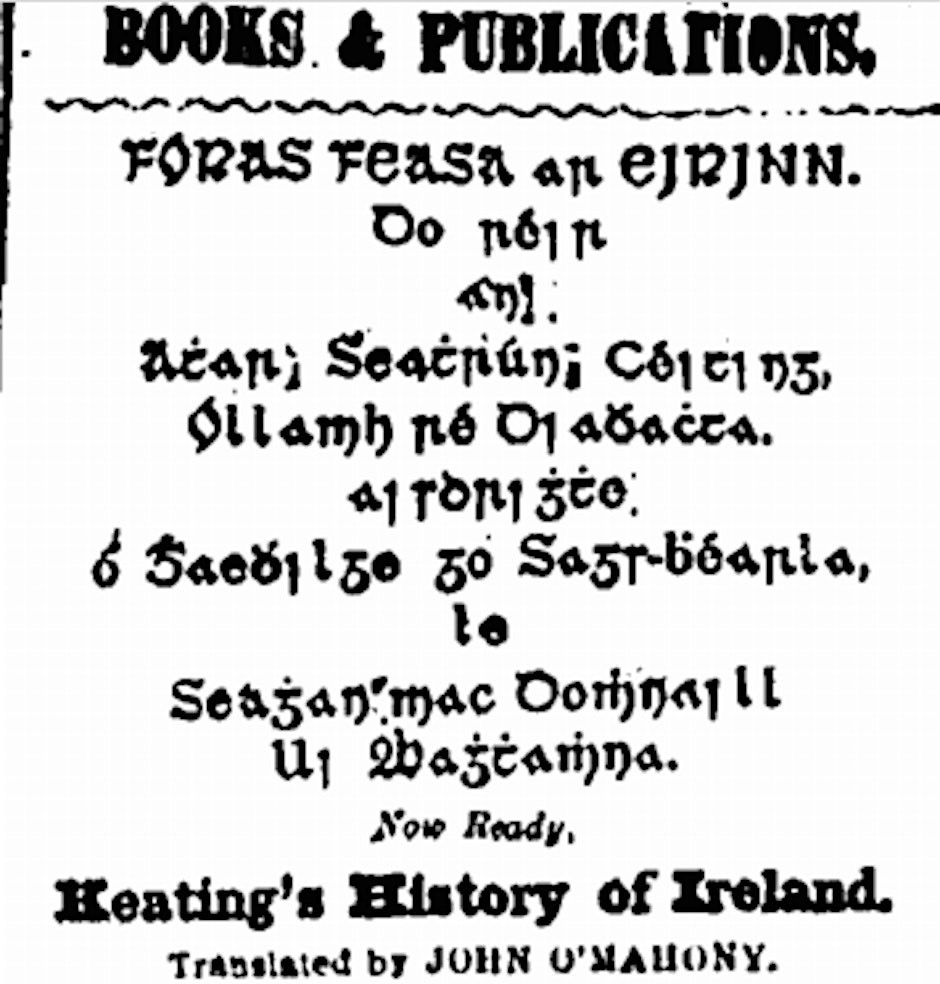
‘Publishing in Irish, Gaelic, and Welsh-speaking communities in 19th century North America’.
This seminar will take place in person in the Institute of Irish Studies, Queen’s University Belfast (27 University Square) and online. You are very welcome to join us in person – parking at QUB is free to the public after 4.30pm – or online.
If you would like to join the USIHS mailing list, please email the Secretary, Dr Sophie Cooper, at usihs01@gmail.com.
All seminars will take place at 6pm in Institute of Irish Studies, 27 University Square, 01/003, Queen’s University Belfast. If you would like to attend online, please get in touch and I will send you the Teams link.
Thursday 24 October: Medieval Panel
John Marshall (TCD), ‘Core or Periphery? Reinterpreting the Place of Ireland in the Marshal Transnational Lordship, 1189-1245.’
Tara Shields (QUB), ‘Late Medieval Lough Derg: The Annalistic Evidence’
Patrick McDonagh (TCD), ‘A Castle of Bones: Towards a Prosopography of the Liberty of Ulster’.
Thursday 21 November: Niall Ó Ciosáin (UoGalway), ‘Publishing in Irish, Gaelic and Welsh-speaking communities in 19th century North America’.
Thursday 5 December: Andrew Mackillop (UoGlasgow), ‘Corporation, Province, and Empire: Ulster and the English East India Company, c.1700-c.1820’.
Parking at QUB is free and open to the public from 4.30pm. Parking is available on the street and in the carpark by the McClay Library.
Please feel free to circulate this list to anyone who might be interested in attending. If you would like to be added to the USIHS mailing list, please email usihs01@gmail.com. Students and members of the public are especially invited to attend.
Dr Clodagh Tait: ‘Margaret Isabella and the fairy in the churn: Women’s folklore and girls’ histories’
Thursday 9 May at 6pm. Public Record Office of Northern Ireland, 2 Titanic Boulevard Titanic Quarter Belfast BT3 9HQ(and online via Zoom)
The Ulster Society for Irish Studies (USIHS) and the Public Record Office of Northern Ireland (PRONI) would like to welcome you to the annual 2024 Beckett lecture, in memory of the late Professor J. C. Beckett. This year’s talk will be by Dr Clodagh Tait of Mary Immaculate College, Limerick. The lecture is free and open to the public.
The last decades have seen a flourishing of studies of Irish women’s history and writing, providing new insights into women’s roles in politics, communities and domestic life, and greater understanding of how they grappled with the strictures placed on their freedoms. However, some women are inevitably less visible than others in the surviving sources. The Irish folklore collections (compiled from the 1930s), publications on folklore and folklife, and a variety of other sources, can help to fill some of the gaps in our knowledge about women’s experiences, customs and worldviews. In this paper I will discuss women’s folklore, considering in particular stories told by girls and women about the ways of the ‘good people’, or about childhood experiences interpreted as being encounters with fairies. Worn smooth and warm with retelling (though there are hints at sharp edges too), these stories assist us in reconstructing supernatural beliefs and the actions they prompted. And they also reveal something about how narratives about fairies were shaped by community input, how personal pasts were recollected, and how girls’ histories were handed down.
Clodagh Tait lectures in Mary Immaculate College, Limerick. She has written extensively on early modern Irish social and cultural history, including the history of women and men; pregnancy, childbirth and child-rearing; death, violence, martyrdom and protest; religious devotion; and the history of emotion. Her recent articles include studies of a Cork ghost story from 1688-9, of accounts of ‘crisis apparitions’ in Ireland and the USA, and of the magical and supernatural labours of women in the nineteenth and twentieth centuries. She is working on an anthology of women’s folklore and a book on cursing and blessing in Ireland over 400 years. She is joint editor of Irish Historical Studies.
‘Castle and City: Dublin Castle in its urban context, 1801-1923′
Thursday 18th April at 6pm. This talk will take place in person at Queen’s University Belfast (Institute for Irish Studies, 27 University Square) and online. If you are planning on attending in person, please remember that the carpark by the McClay Library is open and free to everyone from 4.00pm each day.
Dr Joe Curran is currently a postdoctoral researcher on Maynooth University’s PARISH (Preserving and Recording Ireland’s Sacred Heritage) Project in collaboration with the University of Notre Dame. He previously worked as an Irish Research Council Government of Ireland Postdoctoral Research Fellow at Trinity College Dublin. This project ‘An Urban History of Dublin Castle’, explored the economic, social, and cultural interactions between Dublin Castle and Dublin city during the British-Irish Union.
Stephen Scarth (PRONI): ‘From the Ashes: A history of the Public Record Office of Northern Ireland’
Thursday 15 February 2024, 6.00pm – ONLINE and IN-Person at 27 University Square 01/003, QUB
Stephen is Head of Public Services at PRONI and leads on the marking of PRONI’s 100th anniversary programme of activities and events.
Stephen will explore how the new northern record office responded to the loss of eight centuries of records and evolved into a repository of national significance with over 3 million documents.
‘Praying hearts, praying minds: enclosed orders and online religion‘
Wednesday 13th December at 6pm (QUB – Meredith Room, 23 University Square and online via Zoom)
In 2018 Pope Francis issued the instruction, Cor Orans (‘Praying Heart’), which gave official sanction for the use of digital media by cloistered nuns. The publication of Cor Orans was a major step-change in Vatican directives regulating religious life for enclosed nuns since it was the first time that use of digital media by cloistered communities of women was given official sanction. But the pontiff’s authorisation was not unqualified since it urged the women to use technology with ‘sobriety and discretion not only with regard to the contents but also to the quantity of information and the type’. To date, we lack any critical assessment of how communities of nuns themselves have responded to the pontiff’s instruction at a local level (if in fact they have responded at all). This paper begins an initial assessment of this subject by presenting a case study of the Order of St Clare (OSC), established in 1221 by St Clare of Assisi (1194-1253). How do women for whom strict removal from the outside world is at the very heart of their identity, contend with the vast opportunities for outside communication offered by digital media? What tensions arise between ‘online’ presence and ‘offline’ communal and individual religious identities and affiliations and how can these tensions be mediated? As one of the most austere religious orders in the Roman Catholic Church, the order is an ideal case study for investigating the acute tensions that can arise between the religious ideal of enclosure and withdrawal from the world and the potential for infinite engagement offered by digital and social media.
Dr Bronagh McShaneis a Lecturer in History at the University of Limerick.
‘Apprenticeship to Revolution: Workers and Tradesmen in the 1798 Rebellion’
Thursday 9th November at 6pm (QUB – 27 University Square 01/003 and online via Zoom)
By the end of the eighteenth century, the Irish elite were acutely aware of the dangers of a growing population of urban workers, whether they be in Belfast, Dublin or Cork. This was to be the age of the ‘radical artisan’: skilled, mainly urban, craftsmen, who were highly literate and politically engaged. Unsurprisingly, it was these workers who would provide some of the most dedicated recruits to the cause of the United Irishmen during the 1790s. Yet these artisans never lost their own fierce sense of political independence, often holding socio-economic viewpoints that were very different from those of the middle-class republican leadership. This talk examines the political views, activities, and organizations of these Irish tradesmen in the years running up to the 1798 Rebellion, as well as examining some of the consequence of that rebellion for the country’s urban workers.
Tim Murtagh is a graduate of TCD, completing his PhD in 2015. . He is currently a Research Fellow with the Virtual Record Treasury of Ireland, an all-island project to digitally reconstruct the records of the Public Record Office of Ireland that were destroyed in 1922.
Dr Warntjes is the author of The Munich Computus: Text & Translation. Irish computistics between Isidore of Seville and the Venerable Bede and its reception in Carolingian times (Stuttgart 2010).